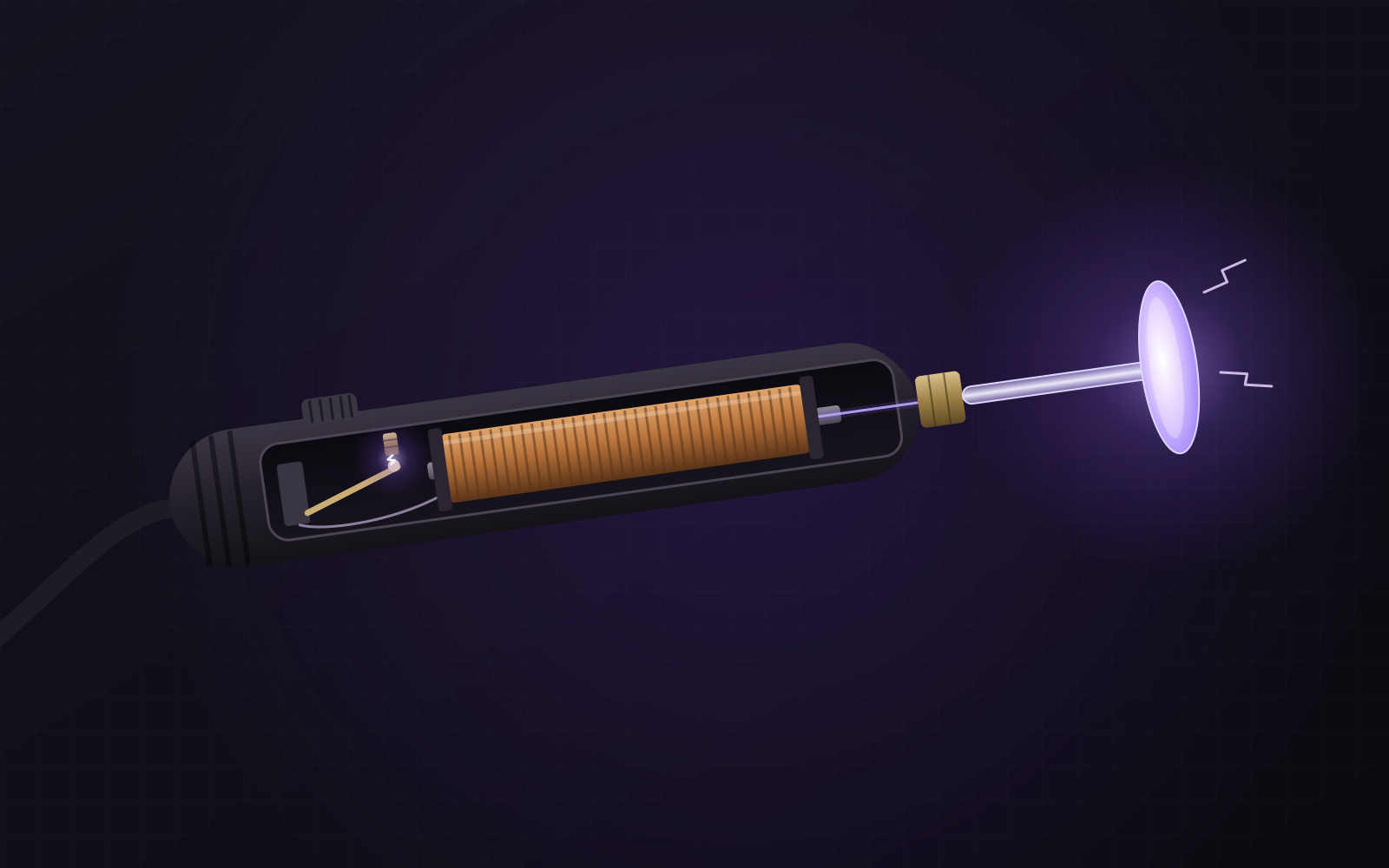
A violet wand takes the electricity from your wall socket and turns it into a very high voltage that flips direction very quickly. That output goes into a glass electrode, which glows. This guide explains each stage so you know what you're looking at. It's not a repair manual.
The three stages#
Most vintage violet wands have the same three working parts, all packed into the handle.
1. The interrupter: the buzz#
The first stage switches the current on and off many times a second. In most vintage wands this is a small vibrating contact, much like the works of an old electric doorbell. That's where the famous buzz comes from.
The knob or thumbwheel on many handles changes how the interrupter behaves, and so how strong the output is. Over the years the contacts burn and pit, which is one reason old wands buzz unevenly or stop altogether.
2. The coil: the step-up#
The switched current feeds a coil, a descendant of the Oudin resonator you'll find in Violet Wand History. Think of it as a transformer with an enormous step-up: a modest voltage in, a very high voltage out, alternating at a high frequency.
This is where the "high voltage" lives. Old insulation inside the coil can break down, and when it does the wand may simply stop, or fail in a way you can't see from outside.
3. The electrode: the glow#
The output reaches the electrode through the metal fitting at the end of the handle. A typical glass electrode is a sealed tube with most of the air pumped out and a little gas left inside. The high voltage makes that gas glow, just like a neon sign.
The colour depends on the gas. Violet and purple are the classic look that gave the device its name. Orange-red usually means neon.
Sparks and that smell#
Bring a glowing electrode near something conductive and the discharge jumps the gap as a small spark. Sparks make ozone, the sharp "electric" smell people associate with a running wand. That smell means the room needs some fresh air. It isn't a sign the wand is healthy.
"But it's safe to touch, isn't it?"#
Old adverts made a lot of the high frequency being the reason you could touch the electrode. Whatever the truth of that for the glass end, it does nothing at all for the mains wiring, the cord, a cracked handle, or tired insulation inside. On a vintage wand those are the real risks. Violet Wand Safety goes into them.
Why old ones fail#
Put the three stages together and the usual faults make sense:
- Worn interrupter contacts give uneven buzzing, weak output, or nothing.
- Ageing insulation in the coil or cord can give up without warning.
- Ageing capacitors, which many designs include, degrade whether the wand is used or not.
- Electrodes that have lost their seal won't glow properly, because air has crept in.
All of these need looking at by someone with the right training and test gear. A wand that won't light is still a complete and interesting object, not a puzzle to solve by plugging it in again.
Glossary#
Short definitions of words used across this site.
Names#
Violet ray. The name used for the hand-held high-frequency devices sold to the public in the early twentieth century. Here it usually means a vintage example.
Violet wand. The more common modern name for the same kind of device, old or new. This site uses it as the general term.
High-frequency device. A broader name for anything built on the same idea, including modern versions.
Set or outfit. A handle sold with its electrodes, case and paperwork. Period cases often say "outfit".
Parts of a wand#
Handle. The hand-held body containing the works. Usually Bakelite, early plastic or metal.
Electrode. The removable glass (or sometimes metal) attachment that fits in the end of the handle. See About Violet Wand Electrodes.
Fitting or ferrule. The metal end of an electrode that goes into the handle.
Socket, chuck or collet. The part of the handle that grips the electrode. See The Violet Wand Collet.
Control or regulator. The knob or thumbwheel that adjusts the output.
Case. The fitted box a set came in, usually with a fabric lining and shaped spaces for each electrode.
Leaflet. The instructions supplied with a set. Historically valuable, but its health claims aren't advice.
Electrical terms#
Mains. The electricity from a wall socket. In the UK, about 230 V at 50 Hz.
Rated voltage. The supply voltage a wand was built for, usually marked on the handle or label. Never connect a wand to anything other than its rating.
High voltage. Voltage high enough to do serious harm. A violet wand makes very high voltage at the electrode and also carries mains voltage in its handle and cord.
High frequency. Electricity that changes direction very rapidly, many thousands of times a second or more.
Interrupter or vibrator. The part that switches the current on and off rapidly, making the buzz.
Spark gap. A small gap that a spark jumps across, used in some designs instead of, or as well as, an interrupter. See What Is a Safety Gap?
Oudin coil or Oudin resonator. A high-frequency coil developed by Paul Oudin in the 1890s, and the basis of the violet ray.
Tesla coil. A related resonant transformer that makes high-voltage, high-frequency electricity, named after Nikola Tesla.
Capacitor. A component that stores charge. Old ones age, and can hold a charge after unplugging.
Insulation. Material that keeps electricity where it belongs, like the covering on a cord. Old rubber and cloth insulation is a common failure point.
Earth. The safety connection in a plug. Many vintage wands have two-pin plugs with no earth.
RCD. Residual current device. A safety switch that cuts the power if current leaks to earth. Called a GFCI in North America.
Isolation transformer. A transformer whose output isn't connected to the mains or to earth. See Which Converter or Transformer Do I Want?
Ozone. A gas made by electrical sparks in air, with a sharp smell. It irritates your airways.
Collecting and restoration terms#
As found. The state of an object when you got it, before any cleaning or repair. Always photograph it first.
Provenance. An object's documented history: where it came from and who owned it.
Original. A part that left the factory with the wand. If you can't confirm it, say "possibly original" or "unknown".
Mixed set. A set whose parts come from more than one original set.
Display piece. A wand kept for study and display, not use. A perfectly good outcome for any vintage wand.
Reversible repair. A repair a future owner could undo without damaging original material.
PAT test. Portable appliance testing. A routine UK electrical safety check on plug-in equipment. Useful, but not a substitute for a proper assessment of an old high-voltage device.
Qualified person. Someone with the training, experience and test equipment to assess or work on high-voltage electrical equipment safely.