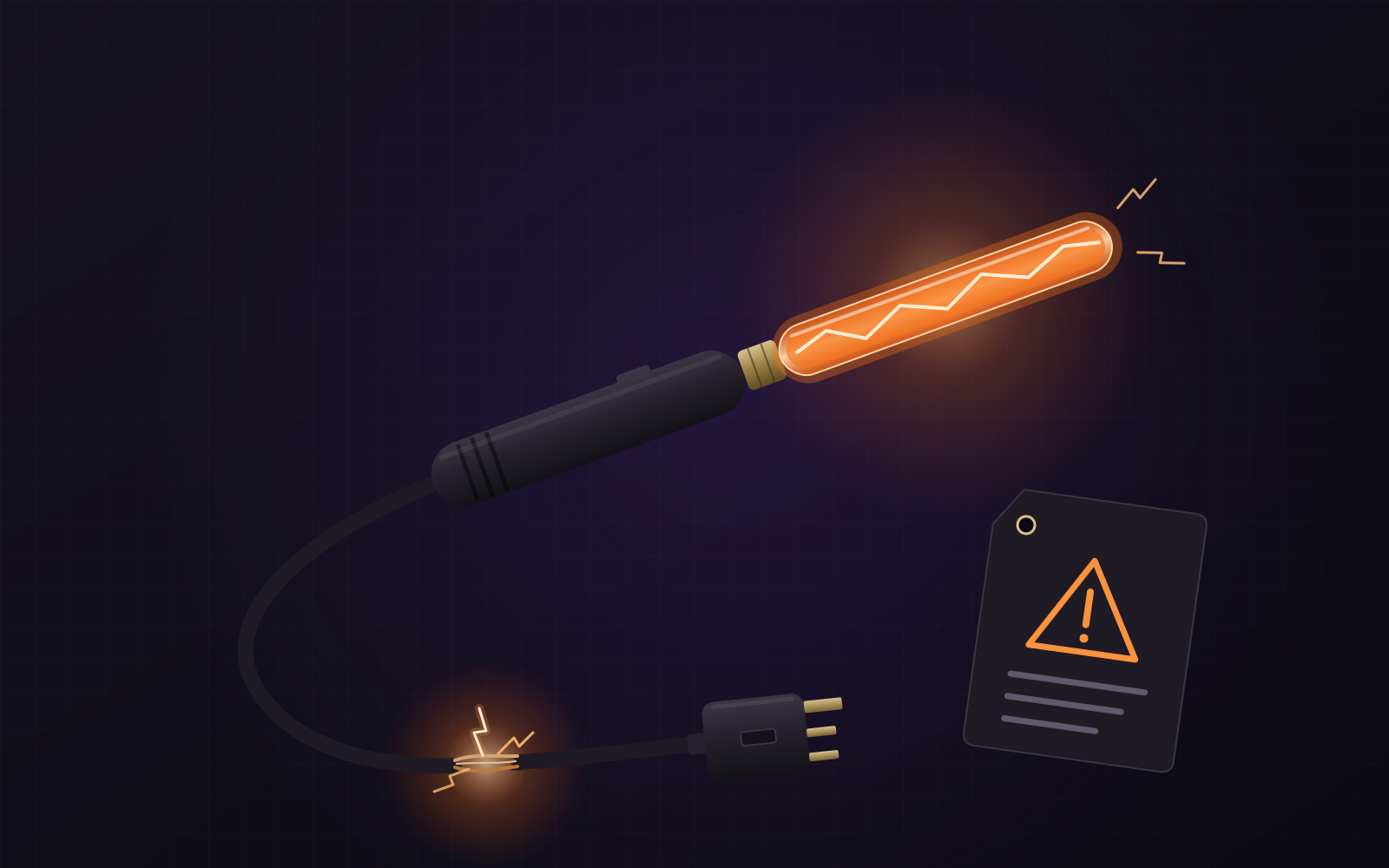
A violet wand is a small high-voltage, high-frequency generator in a handle. It looks gentle, with its soft purple glow, but it's still mains-powered high-voltage equipment, and a vintage one may be pushing a hundred years old. This guide covers the hazards, and then what a safety overhaul should include if you'd like one to run again.
The hazards#
Electric shock#
The glow at the electrode is what catches the eye, but the bigger risk is usually elsewhere: the mains wiring inside the handle and along the cord. Old rubber and cloth insulation cracks and crumbles, handles split, and earlier repairs are often bodged. Any of these can put mains voltage where your hand goes.
Some internal parts can hold a charge after the wand is unplugged. Unplugged doesn't mean safe to open.
Burns and fire#
The discharge from the electrode is a spark. Held in one place it can burn skin, and it can light anything flammable nearby: solvents, alcohol-based products, aerosols and their vapours, hand sanitiser. Oxygen-rich air makes this far worse. Dust and old fabric inside a vintage case will burn too.
Ozone#
Sparks in air make ozone and nitrogen oxides, both of which irritate your airways. That clean, sharp smell is ozone. It means open a window, not that everything's working nicely.
Glass#
Electrodes are thin, hollow glass. They crack, chip and shatter, and old ones may already be damaged in ways that are hard to see. A broken electrode means sharp shards and an exposed contact. See About Violet Wand Electrodes.
Interference with electronics and implants#
A running wand throws out a lot of electrical noise. It can upset nearby electronics, and it's a real concern for anyone with an implanted or body-worn medical device such as a pacemaker, defibrillator, insulin pump or cochlear implant. Anyone relying on one should stay well away from a running wand.
Not a medical device#
Violet rays were once sold with sweeping health claims. They weren't backed up, and nothing on this site treats a violet wand as a treatment for anything, or recommends using one on a person.
Making a vintage wand safer#
A vintage wand in original condition isn't safe to plug in. Its insulation, capacitors and contacts are decades past their design life, and it was built before modern electrical safety standards existed. Keeping it as a display piece is a perfectly good choice.
If you'd like it to run, it needs a proper overhaul first. What follows explains what that should cover so you can talk to a restorer on equal terms. It isn't a set of instructions. Opening and working on high-voltage equipment is a job for someone trained and equipped to do it safely.
1. Cord and internal wiring#
Original cords and wiring were usually rubber or cloth insulated. Rubber hardens and crumbles, and cloth frays and soaks up damp. Either can leave a bare mains conductor touching the handle or sitting where your hand goes.
A sound overhaul fits a modern, correctly rated flexible cord with proper strain relief where it enters the handle, and a plug suited to UK mains with the right fuse. Internal mains wiring is replaced with modern insulated wire rated for the voltage and the heat inside the handle. The restorer should also make sure nothing live can be touched from outside, and decide whether the wand needs earthing or relies on its insulation alone.
Ask for the original cord and removed wiring back. They're part of the object's history even if they'll never be used again.
2. Capacitors#
Many wands contain one or more capacitors, and vintage ones were often wax-impregnated paper, foil or mica. They degrade whether the wand is used or not, absorbing moisture, losing insulation, overheating or failing short.
Picking a replacement isn't as simple as grabbing any mains-rated part. A capacitor across the mains supply should be a safety-rated (X or Y class) type meant for that position. The capacitor in the wand's oscillating circuit has a tougher job: repeated high-voltage pulses. It needs a part rated for that voltage and that kind of duty, typically a pulse-rated film capacitor. It's a fair question to ask your restorer how they chose.
3. Interrupter contacts#
Most vintage wands use a vibrating interrupter: a pair of contacts that open and close rapidly to drive the coil. Over the decades the faces pit, corrode and burn. Worn contacts arc more, run hotter, and make the output erratic.
A restorer can clean, dress or replace them and set the gap so they run steadily. Signs of heavy past arcing, like scorching, melted metal, or carbon tracks on nearby insulation, are worth recording, as they suggest the wand has been run hard or had a fault.
4. An isolation transformer#
This is the biggest single safety addition, and it's covered properly in Which Converter or Transformer Do I Want? In short, it removes the most common way a mains fault turns into a serious shock, but it doesn't make the wand safe on its own, and it stops an RCD protecting anything after it.
5. Electrodes#
Check the glass as carefully as the wand. Look for cracks, chips and loose or corroded caps, and make sure each electrode sits firmly in the socket. One that's lost its vacuum won't glow properly and should be retired. A cracked one should never be used, as it can shatter and expose the contact inside.
When the work is done, ask for#
- a written list of what was replaced, what was repaired and what was left original
- the removed parts, bagged and labelled
- the results of any electrical testing, such as insulation resistance and, if earthed, earth continuity
- confirmation that it suits UK mains voltage and frequency
- any limits on use the restorer recommends
The short version#
- Treat every violet wand as live, high-voltage equipment, whatever its age or condition.
- Assume a vintage wand is unsafe until a qualified person has assessed it.
- An overhaul covers the cord and wiring, capacitors, interrupter contacts and electrodes.
- Keep it away from flammable materials, water, and anyone with an implanted electronic device.
- Keep the original parts and a written record of any work.
- If in doubt, leave it unplugged. A display piece is always an option.