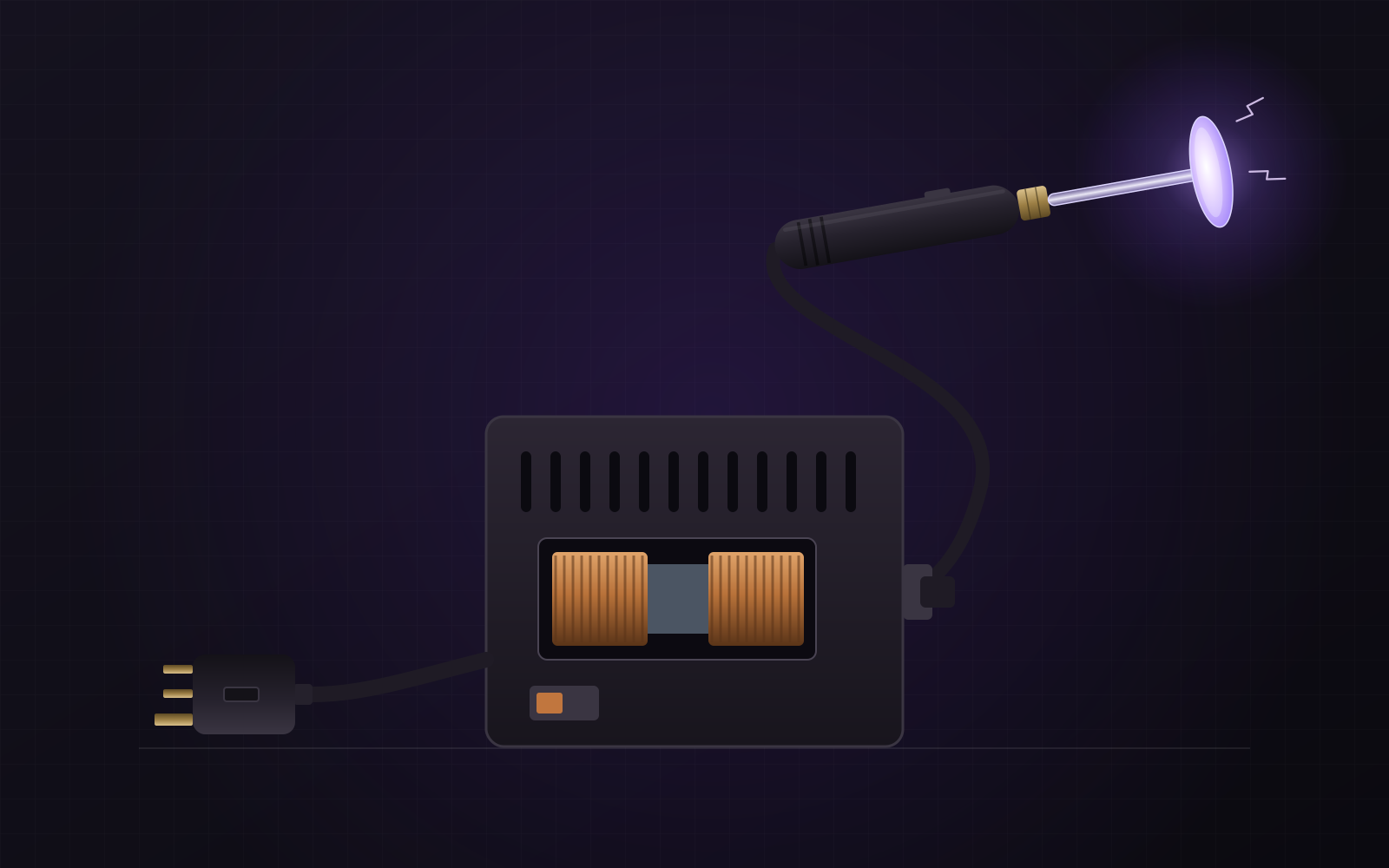
If you've got a 110 V wand and UK mains, or you want an extra layer of protection between the wall socket and an old wand, you'll be looking at transformers. There are several kinds, and they're not interchangeable. This guide explains which does what. It's a guide to choosing, not wiring. Leave the connections to a qualified person.
Travel converters: avoid#
Small, cheap "travel converters" often aren't transformers at all. Many use electronics that chop up the mains waveform to bring the average voltage down. That's fine for a hair dryer for a fortnight in Florida. It's bad news for a violet wand, whose coil and interrupter can overheat or misbehave on a chopped waveform.
Avoid anything sold mainly for travel, anything very small and light for its rating, or anything that says "not for electronic devices" or "for heating appliances only".
Step-down transformers#
A proper step-down transformer has a heavy iron core and copper windings. It takes 230 V in and gives around 110–120 V out, as a clean waveform. This is what a 110 V wand needs.
There are two common types:
- Autotransformer: one winding with a tap partway along. Cheaper, lighter, very common. But the output is still connected to the mains, so it gives no extra safety.
- Isolating step-down transformer: two separate windings, so the output isn't connected to the mains. Heavier and pricier, but it adds the safety benefit described below.
Sizing it#
Transformers are rated in VA (volt-amps), roughly the same as watts for this purpose. Find your wand's power rating, or ask your restorer, and pick a transformer rated at at least twice that. Wands draw more current than you'd expect when they start, and a transformer running near its limit gets hot.
Isolation transformers#
A 1:1 isolation transformer gives out the same voltage it takes in (230 V in, 230 V out), but its output has no direct connection to the mains or to earth.
Why that helps: in a normal socket, if a fault puts a live wire in contact with you, current can flow through you to earth. With an isolation transformer, there's no easy path to earth, so that most common type of serious mains shock is much less likely.
But be clear about its limits:
- You can still be shocked if you touch both output wires at once. Isolation only removes the path to earth.
- An RCD can't protect anything after it. An RCD trips when current leaks to earth. On the isolated side there's no earth path for it to detect. Keep the transformer plugged into an RCD-protected socket, but don't rely on the RCD for the wand itself.
- It must be a proper safety isolating transformer built to a recognised standard (look for BS EN 61558) and rated for the load. A general-purpose or homemade transformer may not give true isolation.
- One wand per transformer. Running several devices from one isolated output brings back a path between them.
- It doesn't touch the electrode hazards: burns, fire, ozone and interference are all still there.
For a 110 V wand, an isolating step-down transformer gives you both jobs in one box.
What about yellow 110 V site transformers?#
UK building sites use yellow 110 V transformers with special yellow plugs. They're robust, easy to find second-hand, and do step 230 V down to 110 V. They're designed so that neither output wire is more than 55 V from earth, which is a clever safety feature for power tools on wet sites.
They can work for a 110 V wand, but they're not the same as an isolation transformer, and you'd need the right connectors fitted properly. Talk to your restorer before going this route.
Quick chooser#
| Your situation | What you want |
|---|---|
| 230 V wand, extra safety | 1:1 isolation transformer (BS EN 61558) |
| 110 V wand, basic | Step-down autotransformer, rated at least twice the wand's load |
| 110 V wand, extra safety | Isolating step-down transformer |
| Anything | Not a travel converter or plug adaptor |
Last thing#
Whatever you choose, label it and the wand clearly so they stay paired. And remember: a transformer helps with the supply. It doesn't fix a tired wand. That still needs a proper overhaul (see Violet Wand Safety).