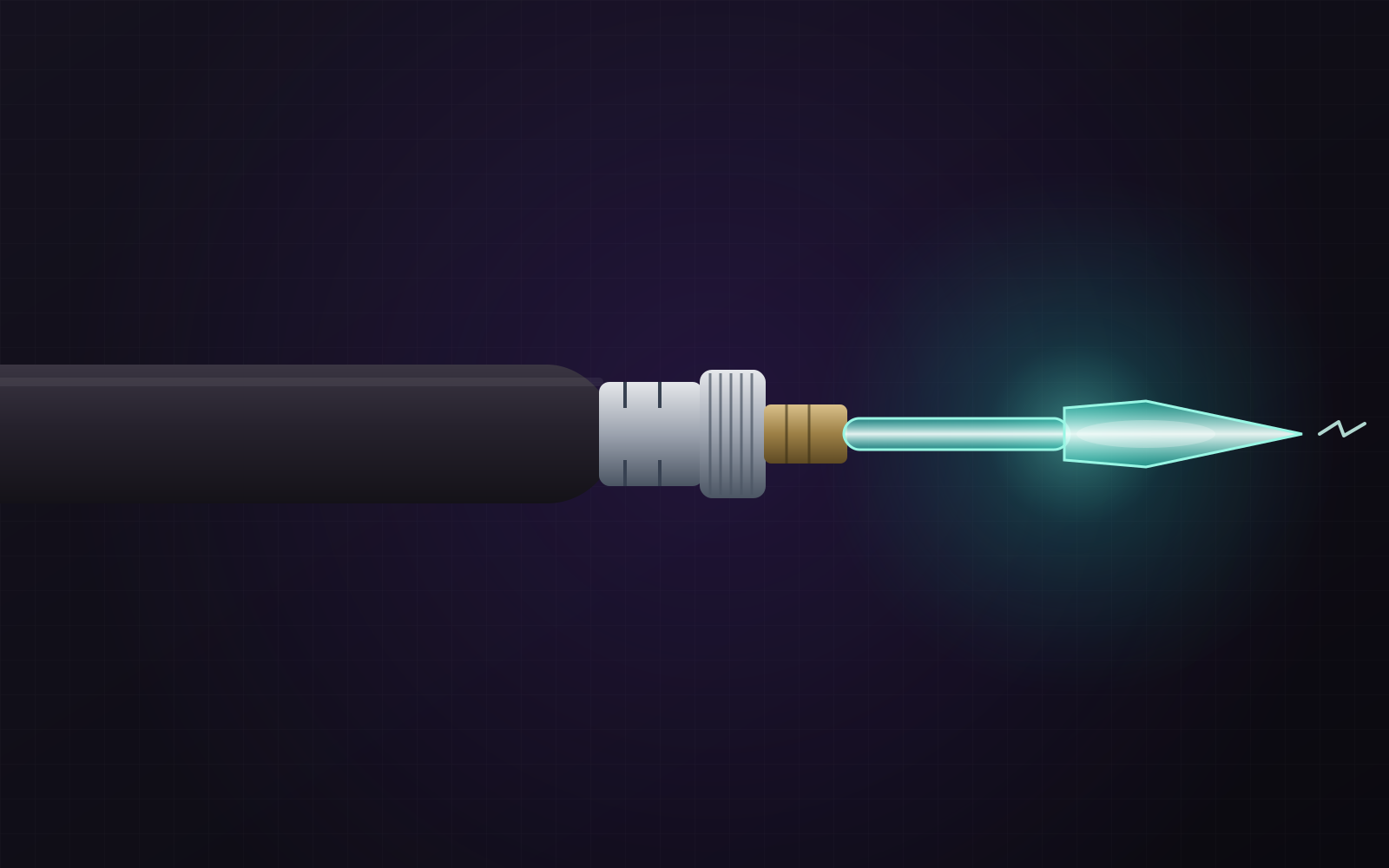
The front of a violet wand handle has a socket that grips the electrode and connects it to the coil. On modern wands it's usually called a collet or chuck. On vintage ones it might be a sprung socket, a screw collar, or a simple push fit. Whatever it's called, it's doing two jobs at once: holding fragile glass securely, and making a good electrical connection.
Why the grip matters#
- Too loose and the electrode can wobble, slip or fall out. A loose connection also sparks inside the socket, burning the contact and heating the electrode's metal cap.
- Too tight and you squeeze the cap hard against the glass, cracking the neck, often invisibly at first.
- Just right and the electrode sits straight, doesn't move when you tilt the wand, and comes out with a firm, gentle pull.
The common types#
Collet with a locking ring#
A split sleeve that closes around the electrode's fitting as you screw down a ring or nose cone. Common on modern wands and some later vintage ones.
Sprung socket#
A socket with a spring or sprung fingers inside that grip the fitting as you push it in. Common on classic violet rays.
Plain push fit#
A simple tube that relies on the fitting being just the right size. Wear makes these looser over time.
Fitting an electrode#
Always with the wand switched off and unplugged.
- Check the electrode first: no cracks, chips or loose caps.
- Hold the electrode by its metal fitting or as close to it as you can, never by the glass head.
- Line it up straight and push in gently, with a slight twist if the socket allows.
- If there's a locking ring, tighten it finger-tight, then stop. No tools.
- Tilt the wand gently. The electrode shouldn't move.
Removing one#
Loosen any locking ring first. Then hold the electrode by its fitting and draw it straight out with a gentle twist. Never lever it sideways.
If it's stuck, stop. Most broken electrodes break while someone is trying to free a stuck one. Leave it in place and get advice. Sometimes a little patience and the right technique frees it, and sometimes it's best left where it is.
Adjusting the grip#
On collets with a locking ring, the ring itself is the adjustment. Snug, not crushed.
On sprung sockets, the springs can weaken over decades. Don't bend the fingers or springs inwards yourself. It's easy to break them or to set them unevenly, which concentrates the pressure on one spot of the glass. A restorer can assess whether they need replacing.
Keeping it clean#
Dust and corrosion in the socket make a poor connection. With the wand unplugged, a soft dry brush is usually enough. Look for green or white corrosion, scorch marks or pitting, and note them. Heavy corrosion or burning means arcing, and that's one for the restorer.
Mixing makers#
Electrode fittings varied between makers and between eras. A modern electrode may be a different diameter to a vintage socket, or a different length. Never force a fit. Violet Wand Electrode and Accessory Fit goes into this.