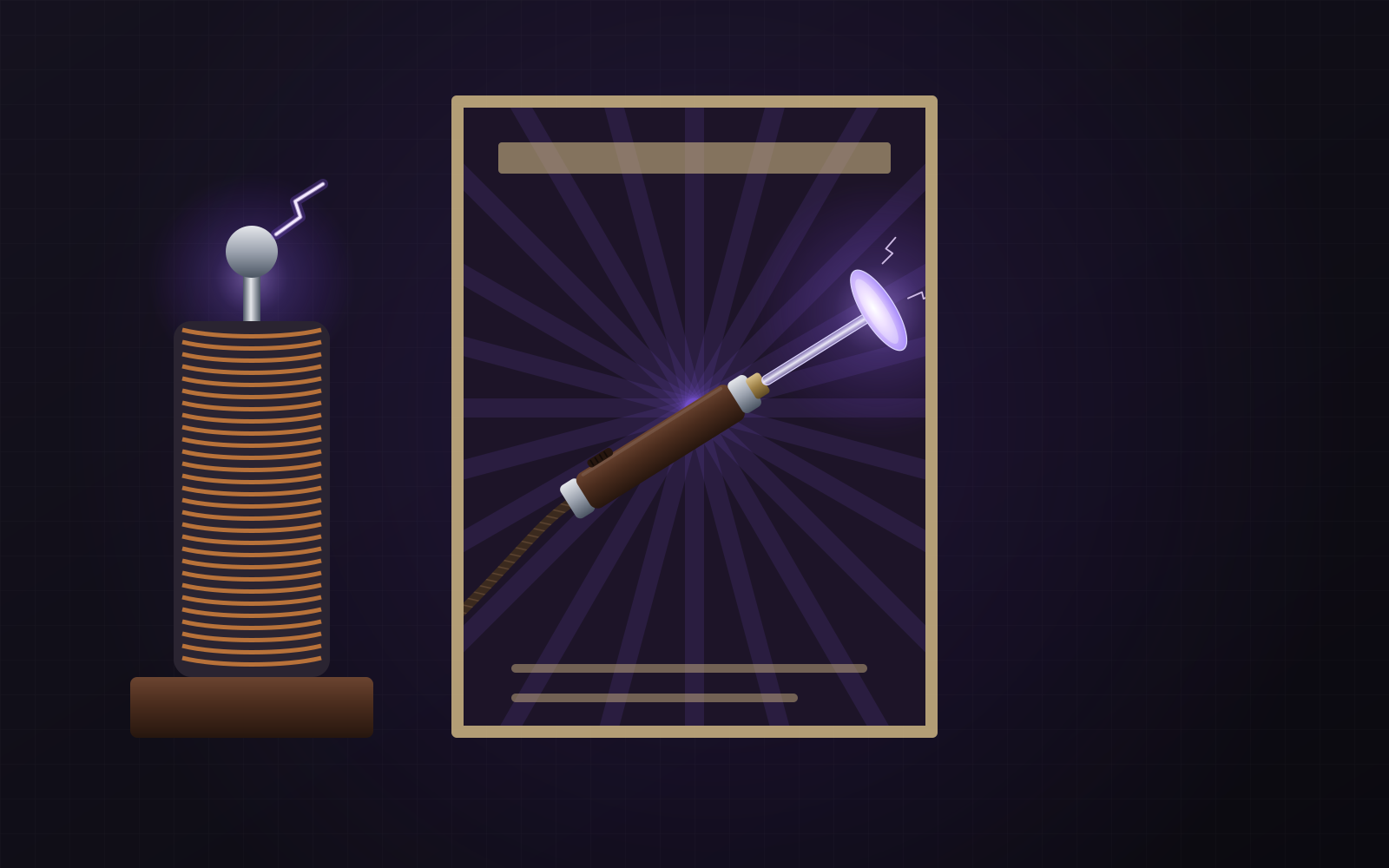
The violet wands that turn up in lofts and auctions today are usually descendants of a device sold in huge numbers in the early twentieth century as the "violet ray". Knowing where they came from helps make sense of what you find in the case: the shapes of the electrodes, the wording on the lid, and the confident promises in the leaflet.
High-frequency experiments#
In the 1890s, several researchers were experimenting with electricity that changes direction extremely quickly, known as high-frequency current. Nikola Tesla is the best-known name, but the work most directly behind the violet ray came from France. The physician Jacques-Arsène d'Arsonval studied the effects of high-frequency currents, and Paul Oudin developed a resonator coil to produce them. That "Oudin coil" became the working heart of the violet ray.
These early machines were big laboratory and clinic instruments. The step that created the violet ray was shrinking the idea into something you could hold in one hand.
From the clinic to the home#
By the 1910s, compact hand-held units were being sold directly to the public. A typical set came in a fitted, fabric-lined case, with a handle containing the coil, a cord and plug, and an assortment of glass electrodes in different shapes. They were advertised in magazines, sold by mail order and in department stores, and sometimes door to door. The same basic design was made by many companies and sold under many brand names, on both sides of the Atlantic.
Their heyday ran roughly from the 1910s into the 1930s, and many of the sets collectors find today date from then. The Classic Violet Ray Outfit looks at a typical set in detail.
The claims#
Violet rays were marketed as cures for a remarkable range of problems: hair loss, aches, poor complexion, "nerves", and much more. Leaflets often included illustrated instructions for using each electrode on a different part of the body.
Those claims weren't supported by evidence. By the middle of the century, American regulators had taken action against makers and sellers over their health claims, and the devices faded from mainstream sale. Nothing on this site treats a violet ray as a treatment for anything, and the original instructions are best read as historical marketing, not advice.
Later life#
The design never quite disappeared. Devices built on the same principle are still made, now usually called violet wands or "high frequency" devices, and they've found their way into hobby electronics and some beauty salons. Newer designs replaced the buzzing interrupter with solid-state electronics (see Electronic or Tesla?). Their modern use on people is outside the scope of this site.
Why they're worth collecting#
Set the claims aside and a vintage violet ray is a fascinating object: early consumer electronics, often with lovely industrial design, printed cases and boxes, and hand-made glass. Sets show how electricity was sold to the public when it was still new in many homes, and how persuasive that marketing could be.
That's the spirit in which this site documents them. If you've just got one, start with Violet Wands for Beginners.