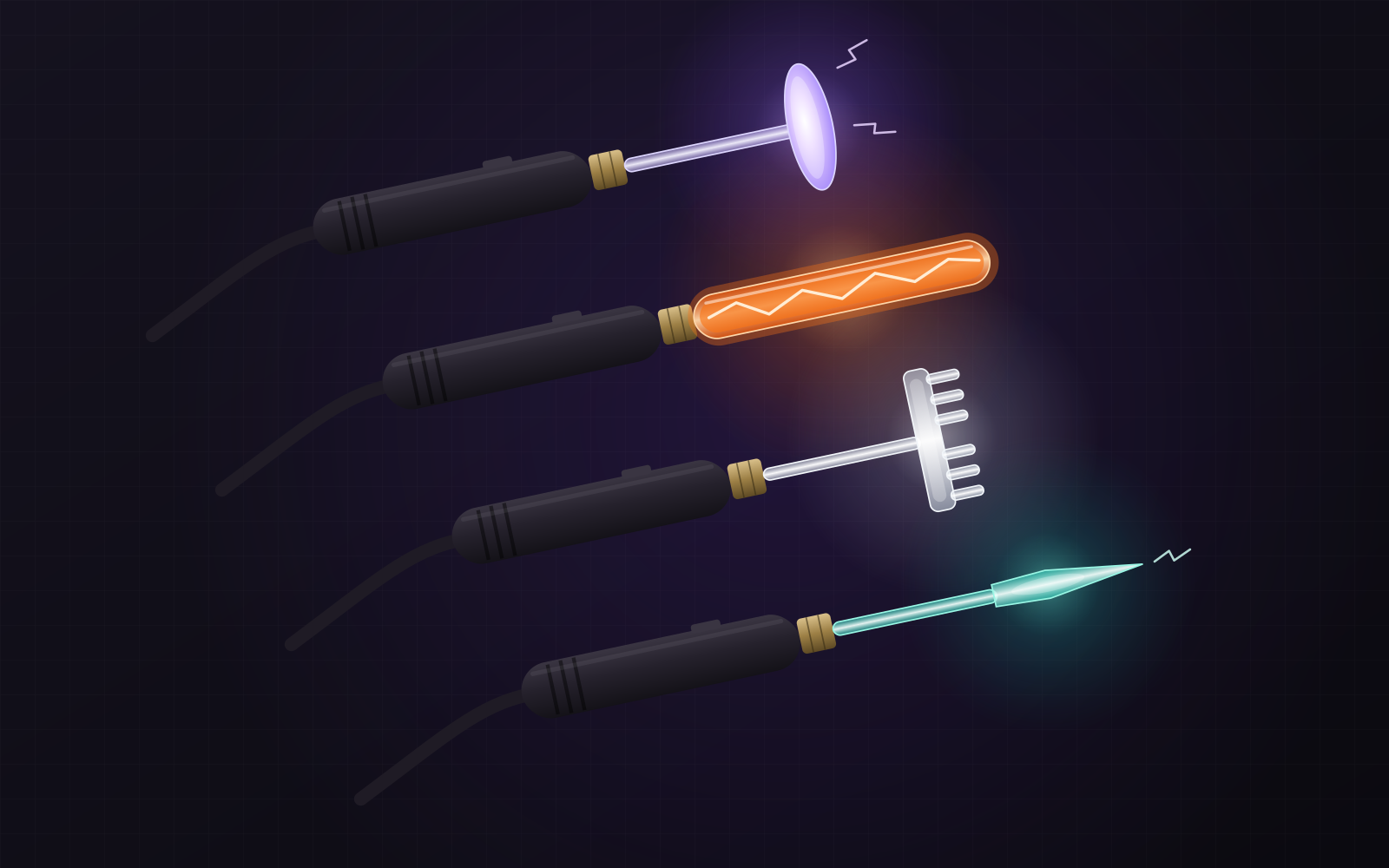
The glass electrodes are the bit everyone remembers: the purple glow, the odd shapes, the crackle. They're also usually the most fragile and the hardest-to-replace part of any set. This guide covers what they are and how to look after them, with the wand unplugged.
What an electrode is#
A typical glass electrode is a hollow, sealed glass shape with a metal fitting at one end. Most of the air was pumped out when it was made, leaving a little gas at low pressure. When the wand runs, the high voltage passes through the fitting and makes that gas glow.
- Blue-violet or purple glow: argon, sometimes mixed with other gases. The classic look that gave the violet wand its name.
- Orange-red glow: neon, giving a warm glow.
- White glow: krypton.
- Greenish-blue glow: mercury vapour. Found in some older electrodes, but no longer used in modern ones because mercury is toxic. Treat a broken mercury electrode with extra care.
Some sets also include metal electrodes, or glass ones with metal inside. These work differently, by touching or sparking directly rather than glowing.
Inspecting an electrode#
Look before you touch, in good light and with a magnifier if you have one.
- Cracks and chips. Check the whole surface, especially the neck where the glass meets the metal. Fine cracks often start there.
- The metal end. Look for corrosion, looseness or old glue. A fitting that moves against the glass is under stress.
- Cloudiness or deposits inside. Note it. It might mean the seal has failed, but you can't tell for sure by eye.
- Earlier repairs. Tape, glue or filler is worth photographing, and a reason to treat the piece as weakened.
An electrode that looks intact isn't confirmed sound. Write "unknown" for anything you can't be sure of.
Before you pick one up#
- Work over something soft, like a folded towel, and sit down if you can. Even a short drop onto a hard table can break one.
- Take off rings and watches that could knock the glass.
- Have a rigid container ready in case anything breaks.
Holding and moving#
Support an electrode along its length with both hands. Never lift it by the tip, and never use the glass as a lever to free a stuck fitting. If one is stuck in a handle, leave it there. Forcing it is how most of them break.
Move one at a time. Don't carry a handful, or stack them in a box where they can touch.
Cleaning#
Less is more. A soft, dry, lint-free cloth removes dust. Avoid soaking, abrasives and solvents: liquid can creep into the metal fitting, and solvents can lift old labels, paint and adhesive that are part of the object's history. If something won't come off with a dry cloth, leave it and note it.
Storage#
- Give each electrode its own padded space so no glass touches glass or metal. Acid-free tissue or inert foam cut to shape both work well.
- Original cases are worth keeping, but old linings can be crumbly or damp. Check the case still holds each piece securely before trusting it.
- Store somewhere dry with a steady temperature, out of direct sun and away from shelves that get knocked. Lofts and garages, with their damp and temperature swings, aren't ideal.
- Label the container, not the glass.
If one breaks#
Keep people and pets away. Wear gloves and eye protection, pick up large pieces with tongs or stiff card, and collect small fragments with damp kitchen roll. Put everything in a rigid, sealed container and wrap it well before it goes in the bin. If the electrode matters to your records, photograph the pieces first.
Never fit a cracked, chipped or repaired electrode to a wand.
More on electrodes#
- Electrode Sizes and Shapes for identifying and describing them
- Violet Wand Electrode and Accessory Fit for matching them to handles
- Charging Electrodes for ones that are slow to light