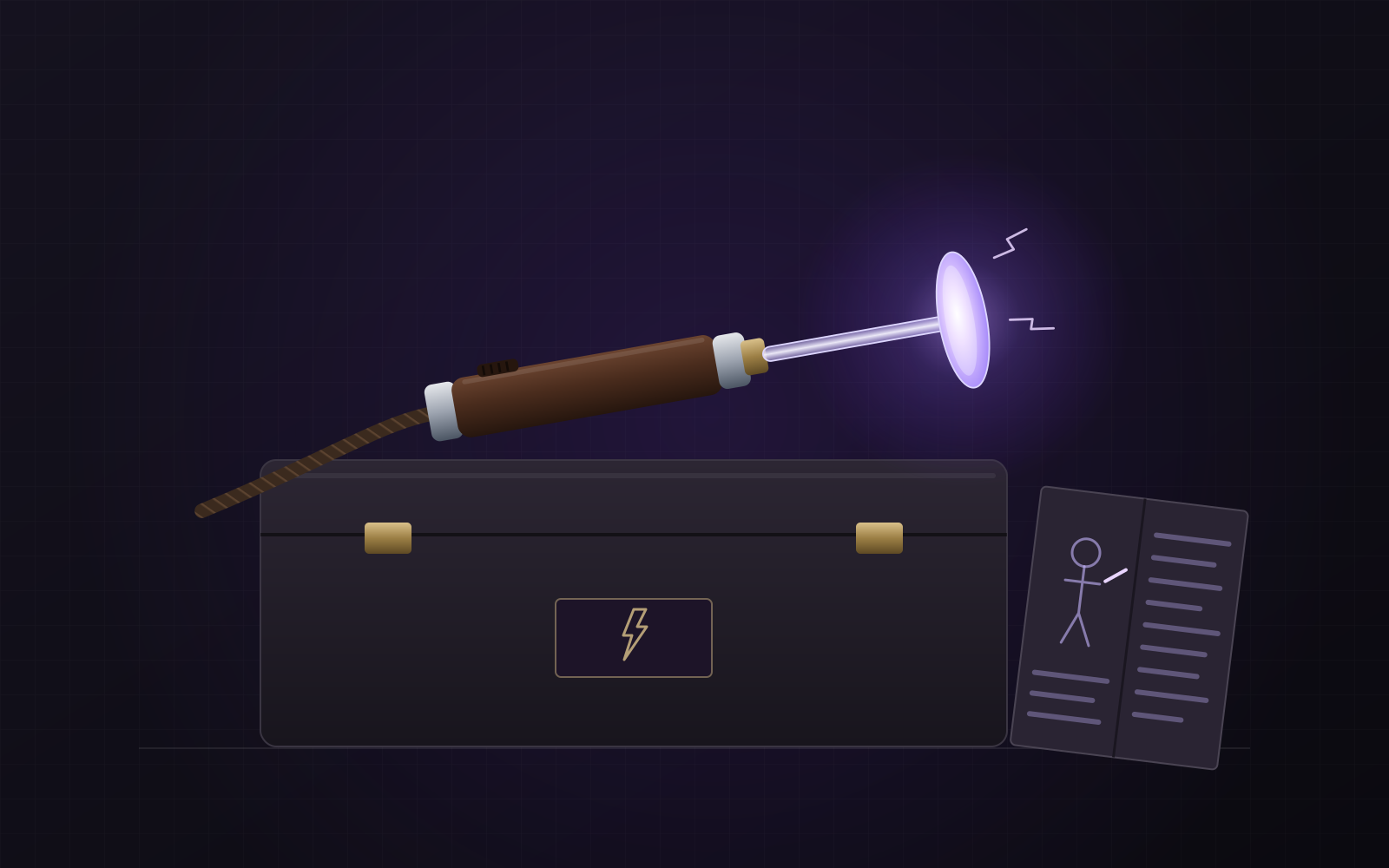
If there's one violet wand that sums up the whole hobby, it's the boxed violet ray "outfit" of the 1910s to 1930s. Different makers sold their own versions, but the formula was remarkably consistent. Once you know the classic outfit, you'll recognise its relatives everywhere.
The case#
Usually a rectangular wooden or card box covered in leatherette, with a hinged lid and one or two clasps. Inside:
- A fabric lining, often velvet or plush in purple, maroon or deep blue, sometimes faded to brown.
- Shaped recesses for the handle and each electrode.
- A printed lid, often with the brand, a trademark, and sometimes instructions or a list of the electrodes.
The case matters. It's often what tells you the maker, and its recesses tell you which electrodes should be there.
The handle#
A long, round handle, usually in black or brown Bakelite or another early plastic, sometimes with nickel-plated brass end caps. Look for:
- a regulator (a thumbwheel or knob, often at the cord end) for adjusting the output
- a socket at the front end for the electrodes
- a label or plate with maker, model and voltage
- the cord, entering at the back, often cloth-covered on early examples
Inside sit the interrupter and the coil. Violet Wand Basics explains what they do.
The electrodes#
A typical outfit had somewhere between three and a dozen glass electrodes. The usual suspects:
- Mushroom or surface electrode: a round, flattish disc on a short stem. The most common, and often the sole survivor.
- Comb: a row of glass teeth. Check every tooth for chips.
- Fine point: a narrow tube tapering to a tip. Fragile.
- Spoon or curved: a broad, gently curved head.
- Straight or bent tube: plain tubes of various lengths.
Most glow violet. Some sets included one or two orange neon pieces. Electrode Sizes and Shapes has more detail.
The paperwork#
The leaflet or booklet is often the most fragile part of the set, and one of the most interesting. Expect:
- a list of electrodes with names and numbers
- diagrams of the wand being used on different parts of the body
- bold health claims that wouldn't pass any advertising standards today
- the maker's address, which can help with dating
Keep it, protect it in an acid-free sleeve, and read it as social history, not instructions.
What a "complete" outfit looks like#
A truly complete outfit has:
- the case with its lining intact
- the handle with its original cord and plug
- every electrode the case has a space for, all intact
- the leaflet
- ideally, the outer box
Very few survive like that. Most have lost an electrode or two, gained a replacement cord, or swapped glass with another set along the way. That's all part of their story, and it's worth recording as carefully as the parts themselves.
Condition notes to make#
When you document an outfit, record the state of the lining, any damage to the case, every marking on the handle, the cord type, and each electrode's shape, size and condition. The comparison guide has a checklist for recording markings.