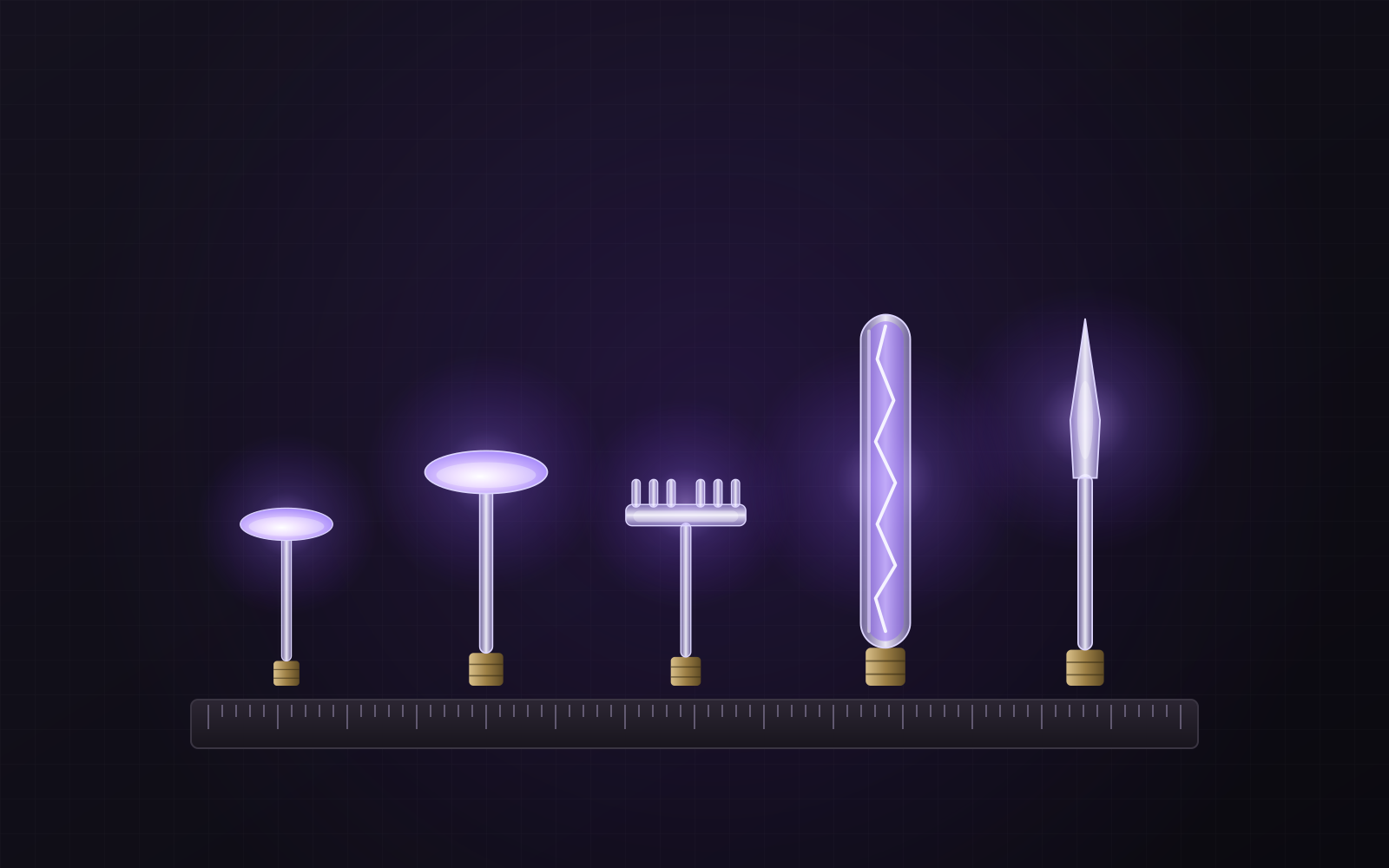
A violet wand set usually comes with several glass electrodes in different shapes and sizes. This guide is for identifying and describing them. The purposes printed in old leaflets were marketing, not advice, so they're left out here.
Names vary between makers and between collectors. When in doubt, describe the shape plainly rather than forcing a name onto it.
Common shapes#
Mushroom#
A short stem ending in a rounded, flattened disc. The most common shape, and often the one that survives when the rest of a set is lost. Discs range from about a thumbnail to palm-sized.
Comb#
A glass body with a row of teeth, like a hair comb. The teeth are thin and often the first part to chip, so check every one.
Fine point#
A narrow electrode tapering to a fine tip. Some leaflets call these "fulgurators" or "sparking" electrodes. The tip is very fragile.
Spoon or curved#
A broad, gently curved head on a stem. Sometimes listed as "body" or "general" electrodes.
Straight or bent tube#
Plain glass tubes, straight or with a bend, from short and stubby to long and narrow. Lots of different names were used for these.
Bulb#
A round glass ball on a stem. Less common in vintage sets.
Metal or part-metal#
Not every electrode is a gas-filled glass tube. Some sets include metal rods or fittings, sometimes partly covered in glass or another material. They're easy to mistake for unrelated parts. See About Violet Wand Accessories.
Sizes#
There's no universal size chart for vintage electrodes. Lengths, head sizes and fitting diameters all varied between makers. Within one set, though, the fittings should all match the handle.
Roughly speaking, most vintage glass electrodes fall somewhere between about 8 and 20 cm long. Fitting diameters vary from maker to maker, and are best measured rather than guessed. Violet Wand Electrode and Accessory Fit explains how.
Colour#
The colour an electrode glows gives a clue to the gas inside. Most give the classic violet or purple, and orange-red usually means neon. You can't tell the glow colour from the outside of the glass, and testing means powering a wand, so record it as unknown unless you have reliable information.
Describing an electrode#
A consistent description makes a collection much easier to compare. For each electrode, note:
- Shape, in plain words, plus any name printed in the leaflet
- Overall length, and the width of the widest part
- Fitting style, diameter and length
- Glass colour and clarity: clear, tinted, cloudy
- Markings on the glass or fitting
- Condition: cracks, chips, cloudiness inside, loose fittings, previous repairs
For example: "Mushroom, 11 cm long, 4 cm disc, clear glass, brass fitting 9 mm, no markings. Fine crack at the neck, photographed."
Measuring safely#
- Work over a padded surface.
- Use plastic or digital calipers, closed gently. Don't clamp the glass.
- Measure the metal fitting, not the glass neck, for the fitting diameter.
- A ruler laid alongside is fine for overall length.
Handle with care#
Every one of these is thin, hollow, often century-old glass. Read About Violet Wand Electrodes before handling them, and never fit a cracked, chipped or repaired electrode to a wand.