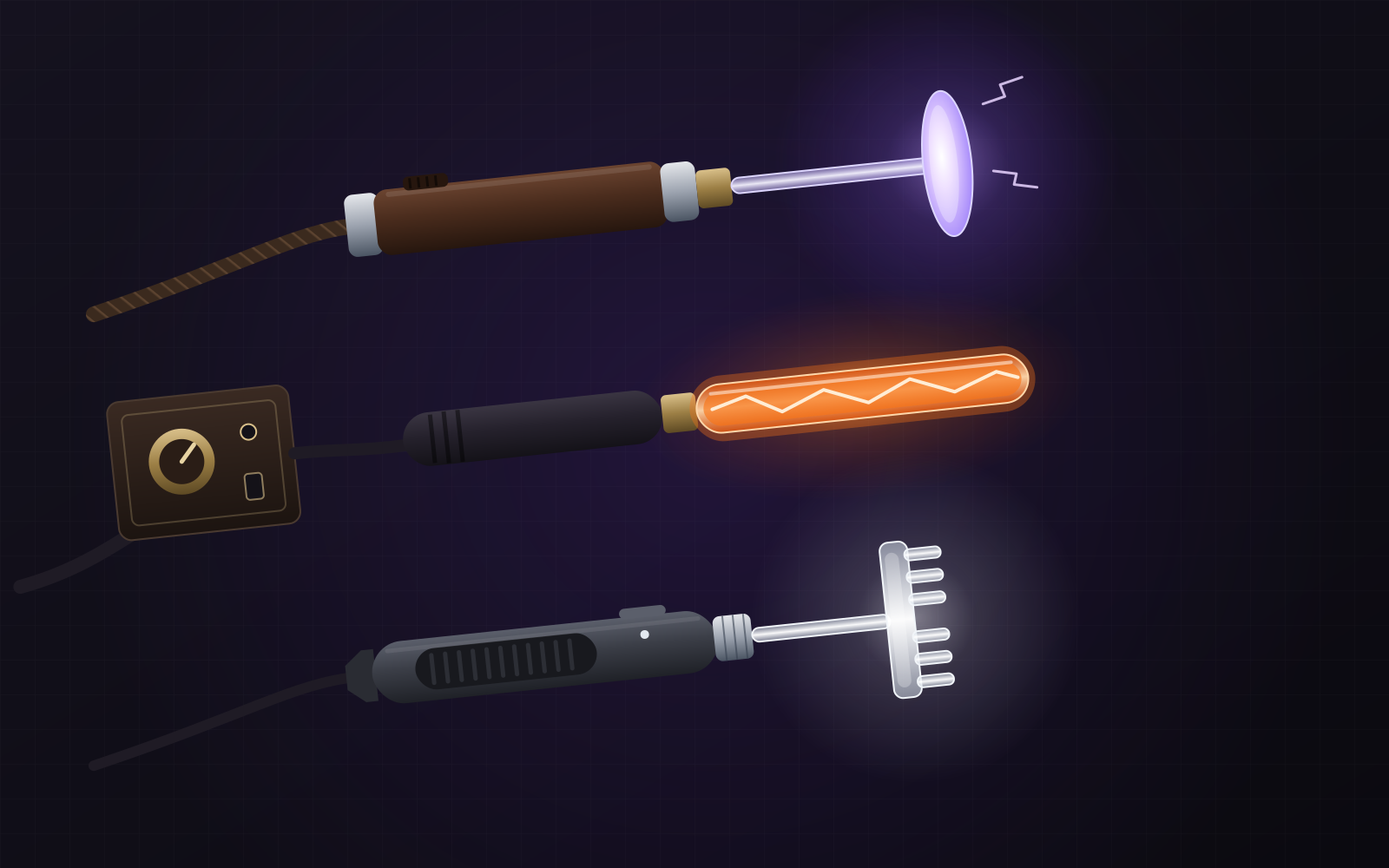
If you've just come across a violet wand, the first question is usually "what is it, and roughly when was it made?" This chart lines up the main kinds you're likely to meet. It's a starting point, not a final answer. Plenty of wands were rebadged, modified or put together from parts over the years.
The chart at a glance#
| Vintage violet ray | Vintage with control box | Modern "Tesla" type | Modern "electronic" type | |
|---|---|---|---|---|
| Typical era | 1910s–1930s | 1920s–1950s | 1970s onwards | 1990s onwards |
| Where the works are | All in the handle | Split between a box and the handle | In the handle | Mostly in the handle, sometimes a base unit |
| How it makes high voltage | Vibrating interrupter driving a coil | Usually the same, sometimes with a spark gap in the box | Interrupter or spark gap driving a coil | Solid-state circuit driving a coil |
| Sound when running | Loud buzz | Buzz, sometimes a crackle from the box | Buzz | Quiet hum or whine |
| Handle material | Bakelite, early plastic, metal | Bakelite or metal | Plastic | Plastic |
| Output control | Thumbwheel or knob, if any | Knob on the box | Knob or slider | Knob, often smoother |
| Electrodes | Glass, sealed, many shapes | Glass, sometimes metal | Glass, plus metal accessories | Glass, plus metal accessories |
| Typical case | Fitted, fabric-lined box | Larger box or cabinet | Foam-lined case | Foam-lined case or none |
| Mains rating | Often 110–120 V (US) or a local UK voltage | As marked | As marked | As marked |
| Collecting interest | High, especially complete sets | High, less common | Moderate | Low, mostly practical |
There's more on the difference between the two modern types in Electronic or Tesla?.
Working out who made yours#
You can do all of this with the wand unplugged and unopened.
- The handle. Look for a maker's name, model, serial number, voltage rating or patent details. They may be on a paper label, a metal plate, or moulded into the Bakelite. Old labels are often worn, so photograph them in low, angled light.
- The case. The inside of the lid often has the brand name or printed instructions. Check the lining, clasps and hinges too.
- Paperwork. Original leaflets often name the maker and list the electrodes that came with the set. Keep them even if they're tatty.
- The outer box. These rarely survive. When they do, they often carry the clearest branding.
- Electrode fittings. The metal end of each electrode, and the socket it fits into, varied between makers.
- The cord and plug. These can help with dating, but they've often been replaced.
Names you'll come across#
Some of the names collectors see most often are Renulife, Master and Vi-Rex, but there were many more. Department stores and mail-order firms sold sets under their own names, too. So a brand on the lid is a good start, but it doesn't prove who built what's inside.
Patent numbers#
A patent date tells you the earliest the design could have been made, not when your wand was made. Firms often kept printing the same patent details for years. You can look numbers up for free on Google Patents or Espacenet, and the drawings can confirm whether a design matches yours.
Mixed sets#
Over a century, electrodes and cases get swapped between sets. Signs of a mixed set include:
- electrodes that don't fit the handle, or fit loosely
- more electrodes than the case has spaces for, or spaces that don't match the shapes
- different glass colours, thicknesses or fittings within one set
- a leaflet that lists different electrodes from the ones you've got
A mixed set is still worth having. Just record it as mixed.
Writing it down#
For each set, note:
- every marking, copied exactly, spelling mistakes and all
- where each marking is
- what you think it means, and how sure you are
- what you couldn't identify
Don't be shy about writing "unknown". "Maker unknown, lid printed 'Violet Ray Outfit'" is far more useful to the next owner than a confident guess.
Where to dig further#
Museum collections with online catalogues, digitised magazines from the period (adverts often show the exact case and electrodes), patent databases, and other collectors' documented examples are all good sources. Compare a few before you decide, because wands that look alike can be quite different inside.