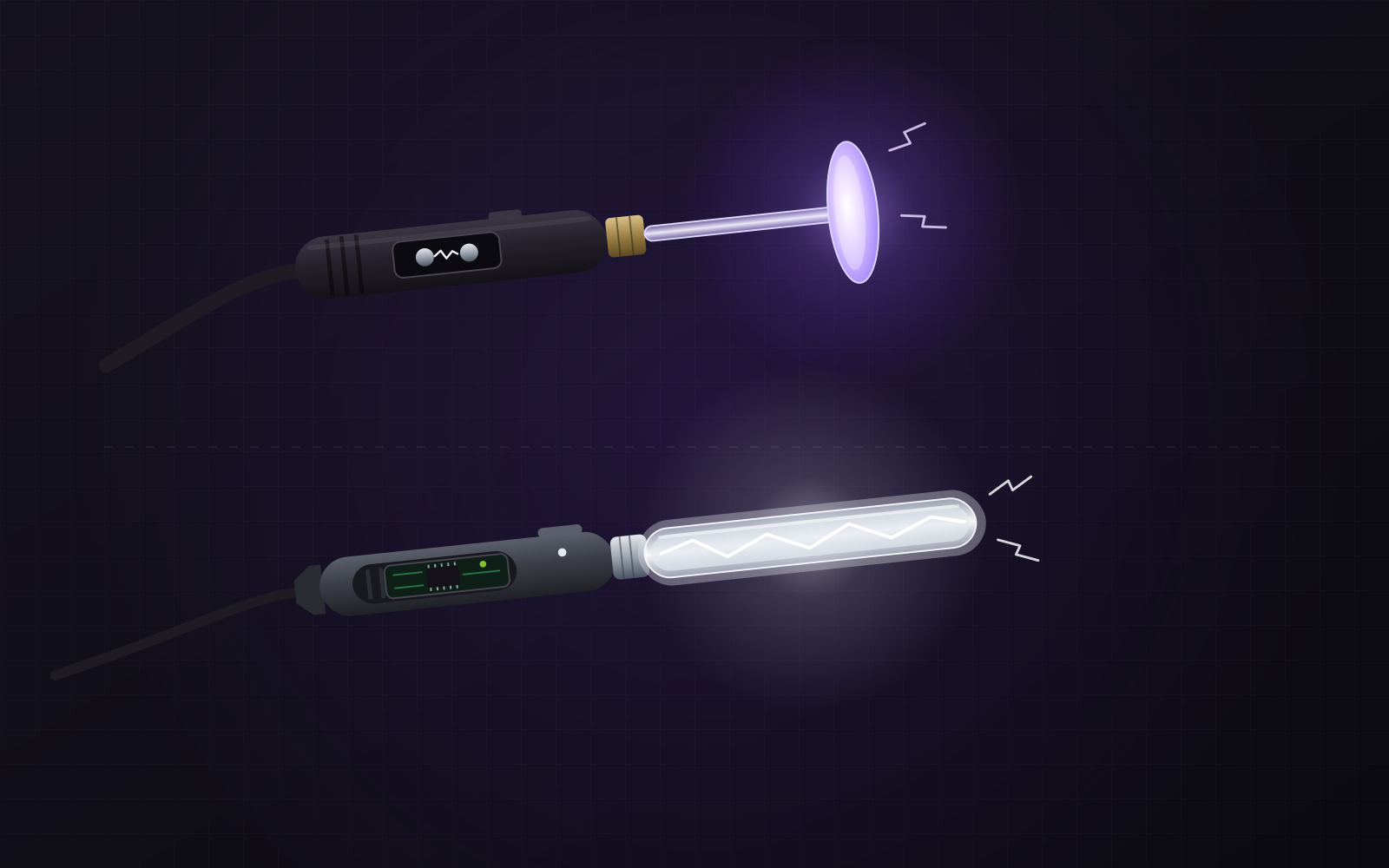
Violet wands fall into two broad families. "Tesla" types make their high voltage with a mechanical switch, a vibrating contact or a spark gap, driving a coil. "Electronic" types do the switching with transistors or other solid-state parts. Every vintage violet ray is in the first family. Knowing which family a wand belongs to tells you a lot about its age, how it behaves and what tends to go wrong.
Tesla types#
The name is a nod to Nikola Tesla's coils, though the vintage violet ray really grew from Paul Oudin's resonator (see Violet Wand History).
How it works: a vibrating interrupter, and in some designs a spark gap, switches current into a coil many times a second. The coil steps it up to a very high voltage.
How to spot one:
- a loud, rough buzz when running
- often heavy, with Bakelite or metal handles on older examples
- an adjuster that changes the buzz as well as the output
- sometimes a visible spark gap or adjusting screw
Good points: strong, punchy output. Simple, repairable mechanics. Huge historical interest.
Things to watch: contacts wear and pit, the mechanism runs warm, and the electrical noise can upset radios and televisions nearby. On a vintage example, everything inside is long past its design life.
Electronic types#
These appeared much later, once cheap power transistors made it practical to switch a coil electronically.
How it works: a solid-state oscillator drives the coil. There are no moving contacts.
How to spot one:
- a quiet hum or high-pitched whine instead of a buzz
- light plastic handles, often modern-looking
- a smooth output knob
- sometimes a separate base unit or a mains adaptor
Good points: quieter, steadier, less maintenance, less interference.
Things to watch: a softer, less "sparky" output. Electronics that are hard to repair once the parts go obsolete. Little interest for collectors so far.
Side by side#
| Tesla type | Electronic type | |
|---|---|---|
| Switching | Vibrating contact or spark gap | Transistors or similar |
| Sound | Loud buzz | Hum or whine |
| Era | 1900s onwards | Mostly 1990s onwards |
| Wear parts | Contacts, spark gap | Few, but hard to replace |
| Interference | Noticeable | Usually less |
| Collecting interest | High for vintage | Low |
Which matters to a collector?#
If it's old enough to have a fitted case and Bakelite handle, it's a Tesla type, and the rest of this site is mostly about those. Modern electronic wands crop up in mixed lots, often with electrodes that won't fit vintage handles (see Violet Wand Electrode and Accessory Fit).
Whichever family you've got, the same rule applies: a wand of unknown condition stays unplugged until a qualified person has checked it.