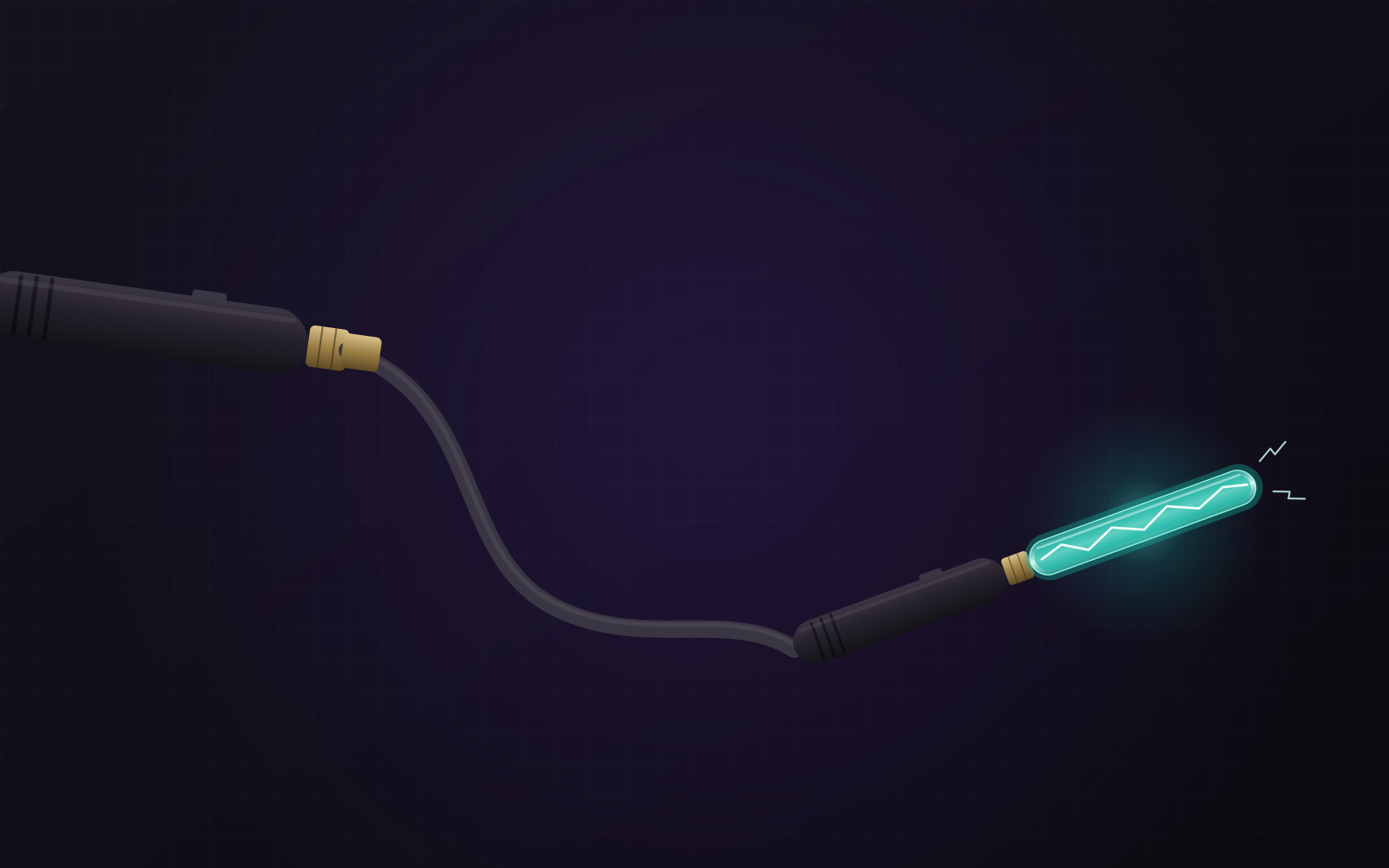
"Extension cable" can mean two quite different things around a violet wand. One carries the wand's high-voltage output. The other is the ordinary extension lead between the wall and the plug. Both deserve some thought.
The high-voltage extension cable#
What it is#
A modern accessory: a lead that plugs into the wand's electrode socket at one end and has a socket for an electrode at the other. It lets the electrode sit some distance away from the handle.
You'll recognise one by:
- a fitting at one end that matches an electrode fitting
- a socket or holder at the other end, often in an insulated handle
- thick, heavily insulated cable in between
Is there a vintage equivalent?#
Not really, as a separate accessory. Some vintage designs did split the works between a control box and the handle, joined by a lead, but that lead was part of the device, not an add-on. If you find a vintage set with an extension-style lead, record it carefully and check whether it's original.
Why it needs care#
- It carries the full output voltage, so its insulation must be in excellent condition along its entire length. A nick, kink or perished patch is a place for the voltage to escape.
- It adds connections, and each one is a possible spot for poor contact, sparking and heat.
- It can radiate interference along its length, a little like an aerial.
- It's not something to improvise. A homemade lead, or a modern one cobbled onto a vintage wand, is a bad idea.
If one comes with a set, record its fittings, length, the state of its insulation and any markings. Retire any with damaged insulation and label it "do not use".
The mains extension lead#
This one's familiar to everyone, and it's worth a quick word because old wands and extension leads don't always mix well.
- Plug straight into the wall where you can. It's one less connection to go wrong.
- If you must use an extension lead, use a good-quality one in sound condition, with its own fuse in the plug.
- Unwind cable reels fully. A coiled reel can get very hot even at modest loads.
- Don't daisy-chain extension leads or plug a lead into another lead.
- Use an RCD, either in the socket or a plug-in RCD adaptor, between the wall and the wand or its transformer.
- Keep it tidy. A trailing lead is an easy way to pull a wand off the bench.
And the wand's own cord?#
On a vintage wand, the cord that comes out of the handle is often the oldest and weakest part of the whole thing. It's covered in Getting Your Violet Wand and Violet Wand Safety. Never try to lengthen an original cord by joining another one onto it.
What this site doesn't cover#
Modern high-voltage extension cables are often sold for using a wand on people. This site doesn't cover that. This guide is about recognising and looking after them.