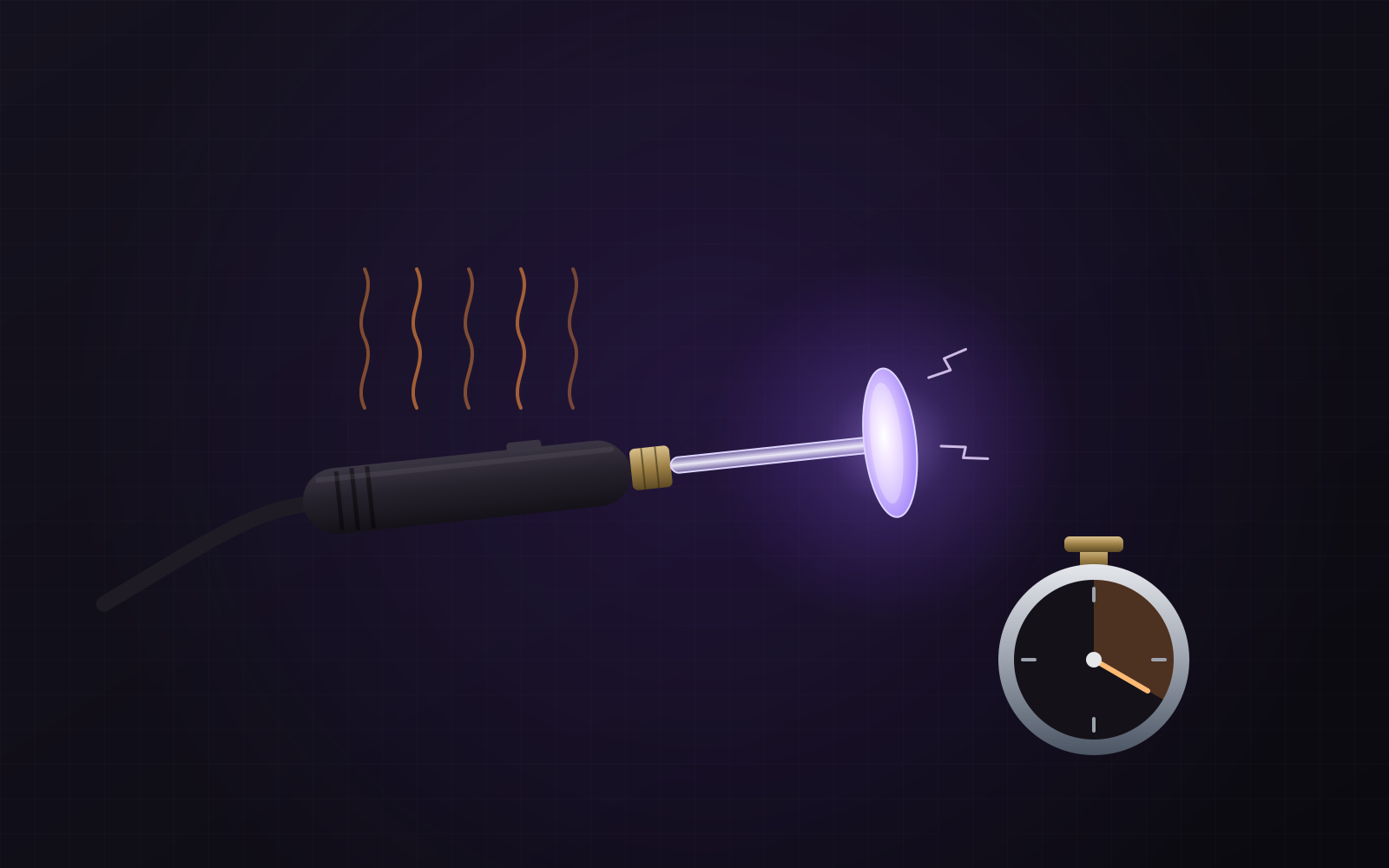
Violet wands aren't built to run all day. Most were designed for short bursts with a rest in between. Run one too long and heat builds up inside the handle, where it does slow, invisible damage. This guide explains why, and how to find a sensible pattern for your wand.
Why they get hot#
Three things produce heat in a running wand:
- The interrupter contacts spark every time they open, and that sparking heats them and the springs around them.
- The coil has resistance in its windings and losses in its core, and both turn into heat.
- Capacitors, where fitted, warm up under the constant high-voltage pulses.
All of that is sealed inside a narrow Bakelite tube with no fan and nowhere for the heat to go. The longer it runs, the warmer it gets inside, and Bakelite is a good insulator for heat as well as electricity.
What heat does#
- Softens and cracks insulation inside the coil and on the wiring, a little more each time.
- Burns the interrupter contacts faster, so the wand gets rougher and weaker.
- Ages capacitors more quickly.
- Loosens joints as metal parts expand and contract.
On a vintage wand that's already old inside, each long session takes something away that you can't get back.
The idea of a duty cycle#
Engineers call the ratio of running time to rest time the duty cycle. A wand that runs for 5 minutes and then rests for 10 has a duty cycle of one third. Most hand-held wands are designed for short running periods with longer rests.
Original makers rarely printed a duty cycle. If your restorer has given you limits, follow those. If not, a cautious approach for an overhauled vintage wand is:
- run for a few minutes at a time
- rest for at least as long as it ran, preferably longer
- keep the output no higher than you need
Modern wands often come with the maker's own guidance. Follow it.
Feel the handle#
Your hand is a good thermometer:
- Cool or barely warm: fine.
- Comfortably warm: time to think about a break soon.
- Hot, or hot in one spot: switch off now and let it cool completely.
A handle that gets hot quickly, or hotter than it used to, is telling you something has changed. Note it in your log and get it checked.
Other signs to stop#
- a smell of hot Bakelite, varnish or burning
- the buzz getting rougher or changing pitch
- the glow weakening as it warms up
- crackling inside the handle
Higher settings, shorter runs#
Running at a high output produces more heat, more sparking at the contacts and more stress on the insulation. If you need a high setting for a moment, keep it brief and drop back down.
Letting it cool#
Rest the wand on a heat-proof surface, not back in its lined case, and let it come right back to room temperature before packing it away. A warm wand shut in a case traps heat and any moisture with it.
See Getting to Know Your Wand on the Bench for a simple running log.